Top Signs You Need Garage Door Service – Don’t Ignore These
A garage door that still goes up and down is not the same as a door that’s working correctly. Most homeowners wait until something stops moving entirely, but the useful warning signs show up weeks or months before that. Here’s the honest version of what to watch for, ranked by how much time you actually have before a small fix turns into a big one.
We’re the team at Garage Door Repair Providence Pros, and we’ve walked into a lot of Providence garages where “it still works” had quietly morphed into a spring about to let go. If reading this makes you want a second set of eyes, call (877) 792-6062 and we’ll take a look.
A door that takes three seconds longer to open than it used to isn’t just slower. It’s a motor working harder than it was designed to, and the difference between a roller replacement now and an opener replacement down the road is a door that’s still moving. That’s the whole idea behind this piece.
Key Takeaways
- Noise and vibration changes are the earliest indicators, and the easiest to dismiss as “just the garage being a garage.”
- One visual check on your cables takes 30 seconds and can tell you whether a snap is imminent.
- A slight lean or off-level door means uneven spring tension, which accelerates wear on everything else.
- An uneven gap at the floor on the spring side is the one sign that means call today, not this week.
1. New or Growing Noise and Vibration (Act Within Weeks)
This is the sign most homeowners shrug off, and it’s the one that matters most. Garage doors are supposed to be almost boringly quiet. If yours has started to rumble, screech, or shake the wall it hangs on, something has changed. A worn roller, a dry hinge, or a loosening track all announce themselves as sound long before they fail outright.
Here’s why noise deserves attention: vibration travels through every moving part. A single bad roller can wear the track it rides in, and an opener working against that drag runs hotter and fails sooner. We’ve seen doors where one squeaky hinge, ignored for a season, turned into a track that had to be realigned and an opener that had to be replaced. The noise wasn’t the problem. It was the messenger.
Walk out to your garage and listen. A smooth open should sound like a low, steady hum. Grinding, popping, or a shudder that rattles the door frame are your cue to get it looked at before something else pays for the wait.
How long you have: addressed early, this is usually a simple adjustment or a roller swap. Left alone, it climbs toward opener and track work.
2. The 30-Second Cable Check That Tells You a Lot
You don’t need tools for this one, and you don’t need to touch anything. Stand inside your garage with the door closed and look at the two steel cables that run down each side, next to the springs. You’re looking for three things:
- Fraying – any strand that looks like it’s coming unwound from the rest.
- A kink or birdcage – a section that’s twisted or bulging instead of running straight.
- Rust spots or thinning – a cable that’s lost its even thickness.
A healthy cable is smooth, taut, and uniformly thick. If either one looks frayed or kinked in Providence, treat it as weeks from failure rather than years. Cables and springs are under extreme tension, and a snapping cable is genuinely dangerous – this is the part you do not want to fix yourself. A trained technician has the right tools and the know-how to release that tension safely.
3. A Door That’s Slightly Off-Level or Leaning
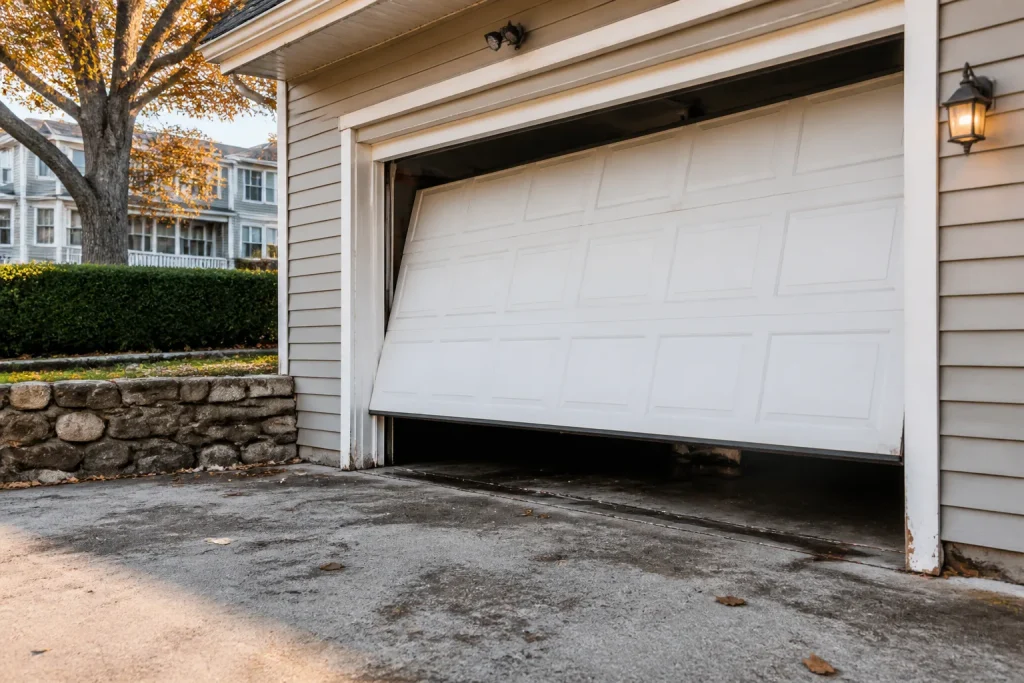
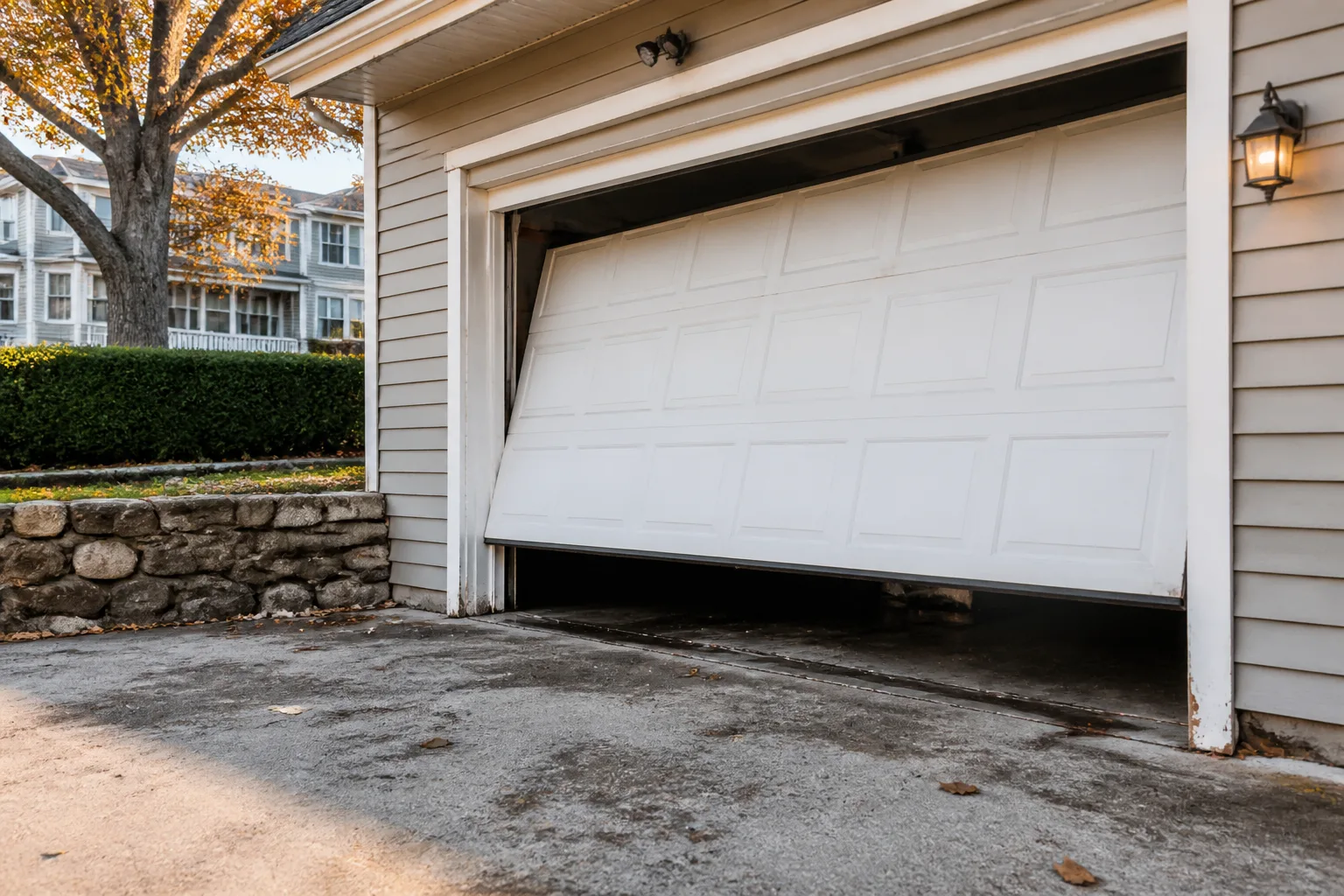
Watch your door as it comes down. Does one side reach the ground before the other? Does the panel look a little tilted when it’s fully open? That lean is a symptom of uneven spring tension, and it’s telling you one spring is doing more work than the other.
The problem with a door that’s out of balance is that it stresses every other part. The opener pulls harder on one side. The tracks take uneven wear. The rollers on the loaded side wear faster. A small imbalance today becomes a chain of repairs because the door is fighting itself on every cycle. If your door leans, it’s worth a professional adjustment before the imbalance takes the opener with it. Whether your hardware is a Clopay or an Amarr setup, the diagnosis is the same: get the tension evened out.
How long you have: this one moves slowly at first, then faster once the stress starts compounding. Don’t let a lean sit for months.
4. The Uneven Gap at the Floor – Call Today, Not This Week
This is the sign that gets bumped to the front of the line. Close the door and look at the gap between the bottom of the door and the floor. If the gap is uneven, and especially if it’s larger on the spring side, stop reading and call. An uneven gap on the spring side usually means a spring has broken, weakened, or slipped, and the door is no longer sitting square.
Broken springs are the most common serious garage door failure we see in Providence. When one goes, the door becomes dangerously heavy and the opener is left lifting way more than it was built for. Don’t force it. Don’t keep cycling the opener hoping it catches. Springs operate under extreme tension and can cause serious injury if handled without the right tools – leave this one to a trained technician, full stop.
If a door fails and leaves your car trapped or your home sitting open, that’s exactly when you want someone who treats emergency work as a core service, not a favor. Call and we’ll move.
5. The Opener Is Struggling or Acting Strange
Your opener has its own set of tells, and they often show up before the door itself gives out. Watch for a door that reverses for no reason, a remote that only works when you’re standing close, blinking lights on the motor unit, or a door that stops halfway and needs a second press to finish.
Some of these are simple: a tired remote battery, a safety sensor knocked out of alignment, a limit switch that’s drifted. Others point to a motor on its way out. The only way to know which is to have it checked. Modern openers from brands like Genie and LiftMaster have different diagnostics, and a technician who works on your brand can tell you whether it’s a quick reset or a replacement – without selling you a new unit you don’t need. That’s the difference between honest repair and a hard sell, and it’s why we work on whatever’s already in your garage rather than steering you toward one brand.
6. A Door That Won’t Close All the Way, or Reverses on Its Own
A door that starts to close, then pops back up, is usually telling you the safety sensors near the floor are misaligned or blocked. That’s often a quick fix. But a door that closes partway and stops, or one that closes crooked and won’t seal, can point to a track problem, a worn cable, or a balance issue.
A door that won’t seal also means a gap to the outside. In Providence, that’s a draft and a security concern rolled into one – a door sitting open at the bottom is a door that isn’t doing its job. If your door won’t close fully and stay closed, get it looked at rather than propping it and hoping.
7. Visible Wear: Sagging Panels, Loose Hinges, Worn Rollers
Run your eye down the door itself. Panels that have started to sag, hinges that hang loose, rollers that look flat or cracked instead of round – these are all signs the door has been working harder than it should. Steel doors from brands like Wayne Dalton and Clopay hold up well, but even good hardware wears.
Worn rollers and loose hinges are the cheapest fixes on this list, and they’re the ones that protect everything downstream. Catching them early keeps the door quiet and the opener comfortable, and it’s a good moment to ask whether your door needs garage door repair or just a tune-up. A quick diagnosis tells you which, and honest repair means we tell you when you don’t need more.
When to Call a Pro
You can check your cables, listen for noise, and watch for a lean yourself. What you shouldn’t do is touch the springs, cables, or opener wiring – those are where a routine adjustment becomes a real risk. If you’ve spotted any of the signs above, or you’d simply rather not guess, we’re the team to call.
Our technicians have up to 10 years of experience and are certified to service eight major door and opener brands – LiftMaster, Chamberlain, Genie, Clopay, Amarr, Wayne Dalton, Craftsman, and Raynor – so we work on your brand, not just the ones that are easiest for us.
Related services in Providence: if your opener is the culprit, see garage door opener repair. If the door itself is beyond saving, garage door installation is the next step. And when you just want a straight answer, Garage Door Repair Providence Pros is where to start.
The Bottom Line
Every sign on this list is a timeline, not a verdict. Noise and vibration are early warnings with weeks of cushion. A lean or an off-level door is the middle stretch, where stress starts compounding. An uneven gap at the floor on the spring side is the one that means today, not next week. The point isn’t to scare you into a call – it’s that the cheapest fixes are the early ones, and the door that “still works” is often the one working hardest to hide a problem.
If you’re in Providence and need help, Garage Door Repair Providence Pros offers free estimates – call (877) 792-6062. Same-day and emergency service when a door traps your car or leaves your home open, and one call handles it from diagnosis through the fix.
Frequently Asked Questions
New noise or vibration. It’s the earliest indicator and the easiest to dismiss, and it usually points to a worn roller or hinge that’s dragging on everything else. Catching it early keeps it a small fix.
Look for fraying, a kink or birdcage bulge, or thinning and rust spots along the cable. A healthy cable is smooth and taut. Any fraying means weeks from failure, so call a pro rather than touching it yourself.
No. Springs and cables operate under extreme tension and can cause serious injury without the right tools. This is a job for a trained technician – it’s exactly the kind of work we handle as a dedicated service.
An uneven gap at the floor on the spring side, a broken spring, or a door that won’t close and leaves your home open. Those are call-today problems. If your car is trapped or the house is unsecured, call (877) 792-6062 and we’ll move.
Written by the team at Garage Door Repair Providence Pros.
Need Garage Door Help?
Call Garage Door Repair Providence Pros - the local pro we connect you with is licensed and insured, here with fast after-hours help in Providence.
(877) 792-6062